
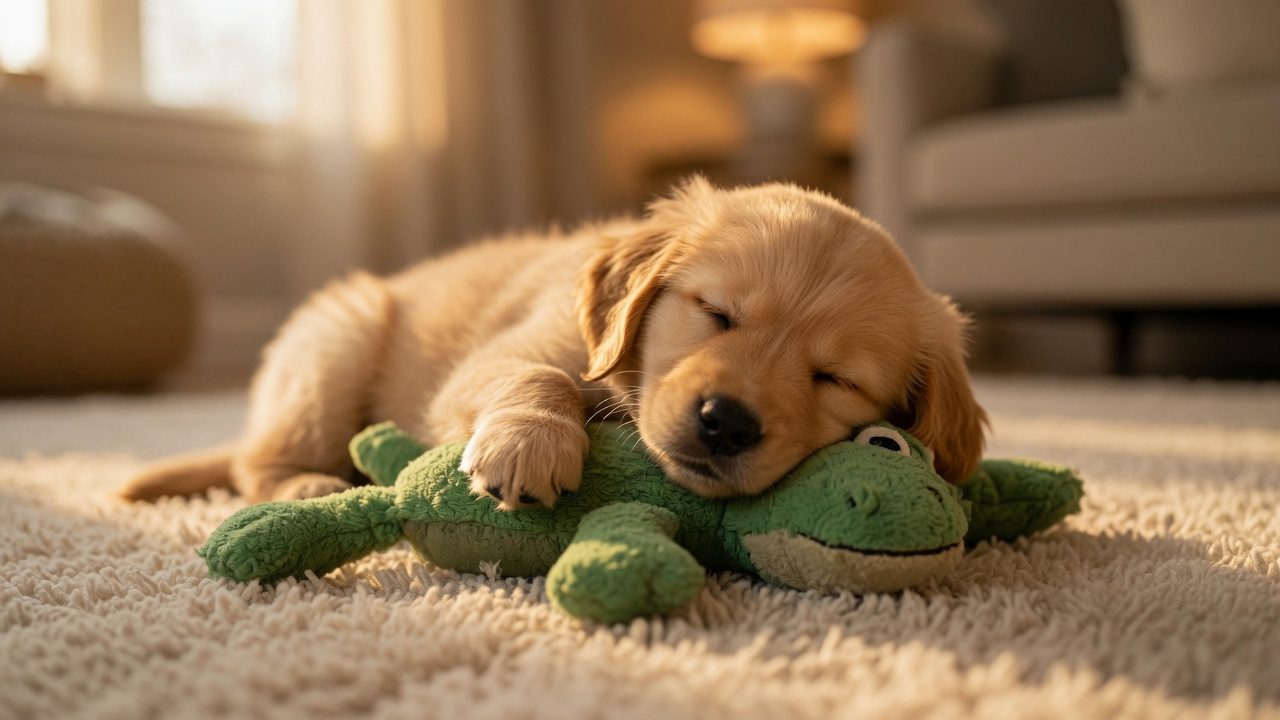
There is nothing quite like a new puppy. The enormous paws they have not grown into. The wobble. The way they fall asleep mid-play, right in the middle of the floor. Finn arrived at Maya and Leo’s home exactly like this, all softness and chaos, and taught them something they had not expected: a puppy is not a small adult dog. A puppy is a whole little language, still learning itself.
Your puppy is not yet fluent in being a dog. They are working it out as they go, trying out signals, sometimes getting them slightly wrong, and watching what happens next. The more gently you learn to read puppy body language, the safer and more understood your puppy feels while they figure it all out.
The big, wobbly, obvious signals
Puppies tend to say everything loudly. Their signals are exaggerated and unpolished, and wonderfully easy to spot once you know what you are seeing.
The play bow, front end down, bottom up, tail going like mad, is usually a puppy shouting “let’s play!” The whole-body wiggle, where the back half swings one way and the front the other, is pure, uncontainable joy. And the mouthing, all those needle-teeth on your hands and sleeves, is not aggression. It is how puppies explore the world and learn, slowly, how hard is too hard. Other puppies teach this beautifully: when one bites too hard, the other yelps and the game stops, and the lesson lands.
The quiet signals that matter most
This is the part most new owners miss, and the part worth slowing down for.
Even tiny puppies use the same gentle “I am not comfortable” signals that adult dogs use: a quick lick of the lips, a sudden yawn when they are not tired, a head turned away, or a small moment of going still. In a puppy, these are easy to walk straight past, because everything a puppy does is small and fast and adorable.
But they matter more than many people realise. When a puppy is being cuddled, passed around, or met by an excited child, those little signals are them saying, as clearly as they can, “this is a bit much for me.” Noticing them, and giving your puppy a break, teaches your puppy something priceless: that you listen, and that the world is safe. A puppy who is not regularly overwhelmed is more likely to grow into a dog who trusts.

The overtired, cranky puppy
If your sweet puppy suddenly turns into a tiny land shark, biting everything, racing in circles, unable to settle, the answer is very often not more play. It is sleep.
Puppies need a remarkable amount of rest, often sixteen to twenty hours a day. And just like an overtired toddler, a puppy who has missed their nap becomes nippy, frantic and cross. It can look like naughtiness. Very often, it is simply exhaustion. A quiet, cosy space and a chance to switch off will do more than any amount of games.
Go gently, they are still growing
Puppies move through phases where the world suddenly feels bigger and more startling than it did the week before. A puppy who was bold on Monday might be wary of the bin on Thursday. This is a normal part of development for many puppies, and it often passes with gentle support and growing confidence.
The kindest thing you can do in these moments is not to force. Do not drag them toward the scary thing to “prove” it is fine. Let them look, let them choose, and let them approach in their own time. Confidence in a puppy is built through gentle, positive experiences, never through pressure.
One quiet note, just in case: the odd wobble is part of growing up, but a puppy who seems persistently fearful, or who is off their food, flat, or unwell, deserves a chat with your vet. Most of the time it is simply puppyhood. Now and then it is worth checking.
Reading the whole puppy
A puppy’s tail, ears, eyes and body all speak at once, just as an adult’s do, only louder and less certain. Learning puppy body language is really just learning to listen a little more closely, and to read the whole of them rather than any single wag or nip. The more carefully you listen now, the easier those conversations often become as your puppy grows.
If you would like to explore this quiet language more deeply, it is at the heart of our little book, Fluent in Dog. Together with Maya, Leo and our curious golden retriever, Finn, it walks you gently through everything your dog is saying, from the very first wobbly weeks onward.
Your puppy is talking to you already, in a language they are only just learning themselves. Meet them halfway, listen kindly, and you give them the gentlest possible start. There is no better gift to hand a brand-new dog.
The Quiet Paw Press 🐾
Leave a Reply