
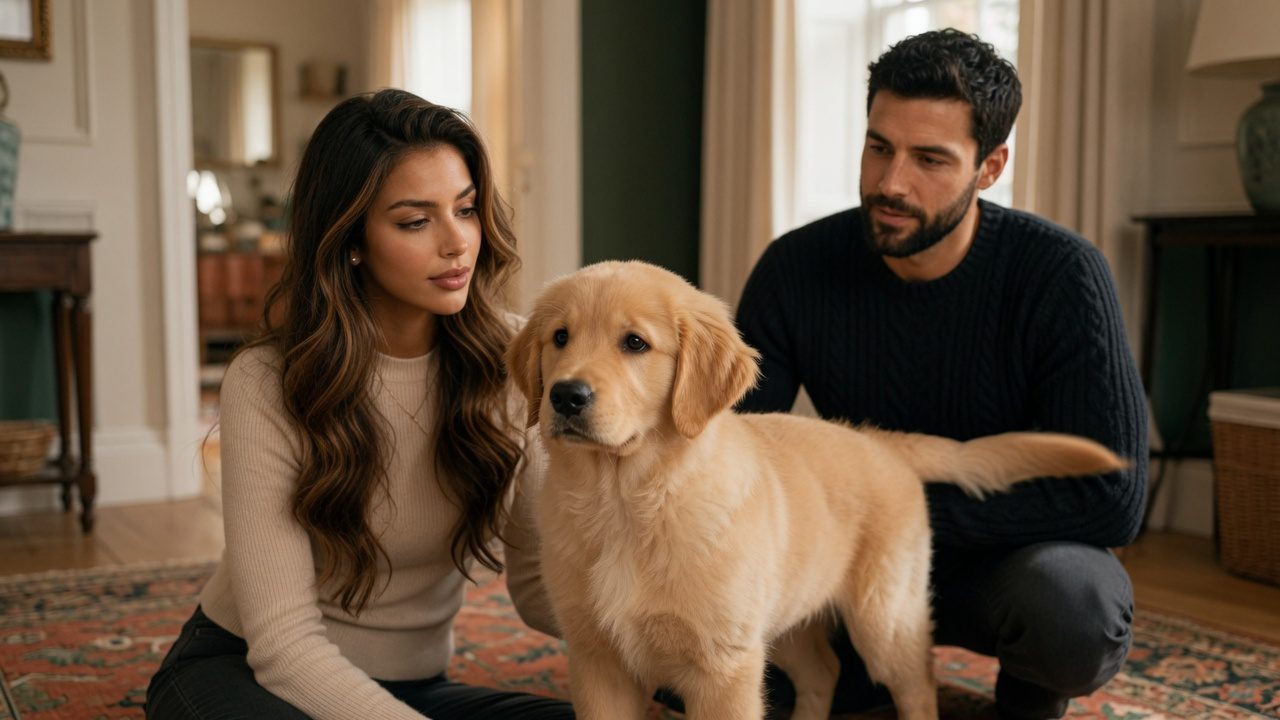
A wagging tail, a yawn, a turned head. Why the same signal can mean different things, and how to work out what your dog is actually telling you.
The lead comes off the hook and Finn does not move.
Finn, Maya and Leo’s five-month-old golden retriever, usually meets the lead somewhere in the middle of the hallway, all elbows and enthusiasm. This afternoon he stays beside the radiator. His tail is going, low and quick. The rest of him is strangely quiet.
Maya crouches to clip the lead on and decides he must be tired. Leo, watching from the kitchen doorway, asks something else. What was happening just before the lead came down?
It is a very small question. It also changes what this moment is able to tell them.
Why one-gesture translations are so appealing
Lists of dog signals with fixed meanings are everywhere, and it is easy to see why. They are quick, memorable and comforting. A wag means happy. A yawn means stress. A belly means trust. If you have ever repeated one of those lines, you are in good company, because most of us learned them from someone who learned them from someone else.
The trouble is that dogs do not communicate in single words. A signal is closer to a piece of evidence than a translation. On its own it narrows the possibilities a little. It rarely settles the question.
Take the tail. Researchers who have studied tail wagging suggest that it reflects emotional activation rather than friendliness on its own. A dog may wag when pleased, uncertain, highly excited or conflicted. The wag tells you something is switched on inside the dog. It does not tell you what.
This is not a reason to give up on reading your dog. It is a reason to read more of him at once.
Read the whole dog
The phrase “read the whole dog” gets used a lot, and it can sound like a slogan. In practice it means something quite ordinary. Before you decide what a signal means, look at everything else the body is doing at the same time.
The areas worth noticing:
How loose or how tight the body is. Soft curves and a little wobble tend to look different from a body held in one line.
Where the weight is. Leaning forward, settled back over the hind legs, or balanced in the middle.
Movement or sudden stillness. A dog who stops moving is often doing something meaningful, though what it means still depends on the rest of the picture.
The eyes and the face. Round and soft, narrow and squinty, wide with more white showing than usual, tension around the muzzle and above the eyes.
The mouth. Open and relaxed, closed and firm, panting that fits the temperature and effort, panting that does not.
The ears. Forward, back, flicking between the two.
The tail. Height, speed, width of the sweep, and whether it moves as part of the whole body or on its own.
Breathing and voice. A held breath, a sigh, a low grumble, a sudden silence where there is usually noise.
None of these needs to be memorised as a checklist. What matters is the combination. A dog with a wagging tail, a loose wiggly body, a soft face and weight rolling forward is telling a fairly readable story. A dog with a wagging tail, a stiff body, a closed mouth and weight back over the hind legs is telling a different one, even though the tail looks the same in both.
That second combination is roughly what Maya is looking at in the hallway, though she has not registered it yet.
What happened just before?
Behaviour does not arrive out of nowhere. Whatever came immediately before it is part of the meaning, and it is usually the piece we forget to check because we were not watching yet.

A dog who has been asleep for two hours moves differently from a dog who has just been chasing a ball. A dog who has been stroked for a while may want a pause. A dog who heard the bin lorry ninety seconds ago may still be carrying some of that. A dog who has been handled for grooming may be sore rather than sulky.
In Finn’s case, Leo’s question has an answer. Two minutes earlier, the neighbour’s gate banged hard enough to rattle. Finn had been dozing. He lifted his head, looked towards the door, and stayed lying down. Then the lead came off the hook.
Nothing in that sequence proves what Finn feels. It does change the range of sensible guesses. “Tired” is one of them. “Still a bit switched on from a loud noise and now being asked to walk towards the source of it” is another, and it fits the low fast tail and the still body more comfortably.
What happens next?
If the moment before gives you the setup, the moment after often gives you the clearest information of all, and it costs nothing but a few seconds of patience.
Watch what your dog does when you pause. Does he come towards you or move further away? Does the body soften and start moving normally again? Does he shake himself off and carry on? Does he go and sniff something with great concentration? Does he settle back down? Or does the signal get bigger, so the stillness becomes a freeze, the low wag stops, the head turns away more definitely?
A dog who moves closer when you give him room is adding useful information. So is a dog who quietly relocates to the other end of the sofa.
This is also the kindest test available to us, because it does not require any interpretation skill at all. You simply stop, wait, and let the dog fill in the next line.
Your dog’s normal is the measuring stick
There is no universal dog against whom your dog can be compared.
Some dogs carry their tails high as a matter of anatomy. Some carry them low and always have. A curled tail over the back may be normal for the breed and say nothing about mood. Floppy ears hide ear position. A heavy beard and eyebrows hide facial tension. A short or docked tail leaves less to read. An older dog may hesitate on a slippery floor for reasons that have nothing to do with feelings and everything to do with joints.
So the useful question is rarely “what does this mean in dogs”. It is “is this usual for him, and if not, what else has changed”.
A dog who has always yawned when the lead comes out is showing you his ordinary routine. A dog who has never yawned at that moment and now does it every time is showing you something worth watching. The signal is identical. The information is completely different.
Four signals that need context
Rather than a dictionary, here are four familiar signals and the honest range of what they might mean.
A wagging tail. It may accompany friendly greeting. It may accompany excitement that is close to tipping over. It may appear when a dog is unsure and weighing up whether to come closer. Look at the height of the tail, the speed, and whether the rest of the body is moving with it or holding still.
A yawn. Dogs yawn when they are tired or have just woken, just as we do. Yawns can also appear in tense or uncertain moments. The question is when it happened. A yawn at eleven at night on the sofa and a yawn while a stranger leans over him are two different events.
Looking away, or a lip lick. In one study of dogs meeting people, lip licking and head turning appeared both when a person approached in a threatening manner and during ordinary friendly greetings, which is a useful reminder that the same behaviour can serve more than one purpose. A dog may also lick his lips because someone is eating toast. Look at the whole body and at whether the dog then moves closer or further away.
Rolling onto the back. Sometimes it is a relaxed dog inviting a belly rub, loose and floppy and blissful. Sometimes it is a dog trying to defuse a situation, body tight, head turned away, legs held stiffly rather than flopping open. Sometimes he is scratching his back on the carpet. The difference is visible if you look past the position itself.
Two plausible readings are not a failure. They are an accurate description of how much one gesture can carry.
A method you can use in a hallway
You do not need a notebook or a slow-motion camera. You need a habit that takes about five seconds.
Pause. Stop what your hands are doing. Most of us interpret while still moving, and the movement changes the thing we are trying to read.
Widen the frame. Look at the whole dog rather than the one part that caught your eye.
Look back. What was happening in the previous half minute? Sound, touch, another animal, a visitor, food, rest, excitement?
Watch forward. Give it a few seconds. Let his next choice tell you more.
Compare with his normal. Is this usual for him in this situation, or is it new?
Hold the conclusion loosely. One occasion is an observation. The same pattern across several similar situations is much closer to understanding.
Maya does this without naming it. She stops clipping, sits back on her heels and waits. Finn’s tail slows. He stands up, shakes himself from nose to tail, walks over and pushes his head into the harness. The gate is quiet again. They go for their walk.
When watching is not enough
Careful observation is not diagnosis, and there are moments that need more than a thoughtful owner.
Please speak to your vet when behaviour changes suddenly or without explanation, when there are any signs of pain such as stiffness, reluctance to be touched, changes in movement, appetite or sleep, or when a previously easy routine becomes difficult. The link is more common than many owners realise. A 2020 review by Mills and colleagues, published in the journal Animals, argued that pain is under-recognised in behaviour cases, and reported that in a sample of one hundred referred dog cases a conservative estimate of around a third involved some form of painful condition.
Alongside veterinary advice, a qualified reward-based behaviour professional is the right next step for persistent fear or distress, for growling, snapping or any risk of a bite, for self-injury, and for any situation you cannot manage safely. Asking for help early is not an admission of failure. It usually means fewer difficult months for everyone.
Back in the hallway
If Maya had gone with her first reading, nothing terrible would have happened. She would have clipped the lead on, Finn would have walked out of the door, and the afternoon would have carried on. That is what makes these moments so easy to miss. They are not emergencies. They pass.
What changes when you widen the frame is not the outcome of one walk. It is the accumulation. Your dog begins to experience you as someone who notices, who waits a moment, who does not insist while he is still deciding. That is quietly enormous, and it is built out of five-second pauses in ordinary hallways.
You will still be wrong sometimes. Everyone is. Reading a dog is not a test you pass, it is a conversation you get better at, and dogs are remarkably forgiving of a person who is clearly trying to listen.
If you would like a simple place to start practising, our free guide, 5 Silent Signs Your Dog Is Asking for Help, looks at five subtle signals that are easy to miss in everyday life.
Leave a Reply