
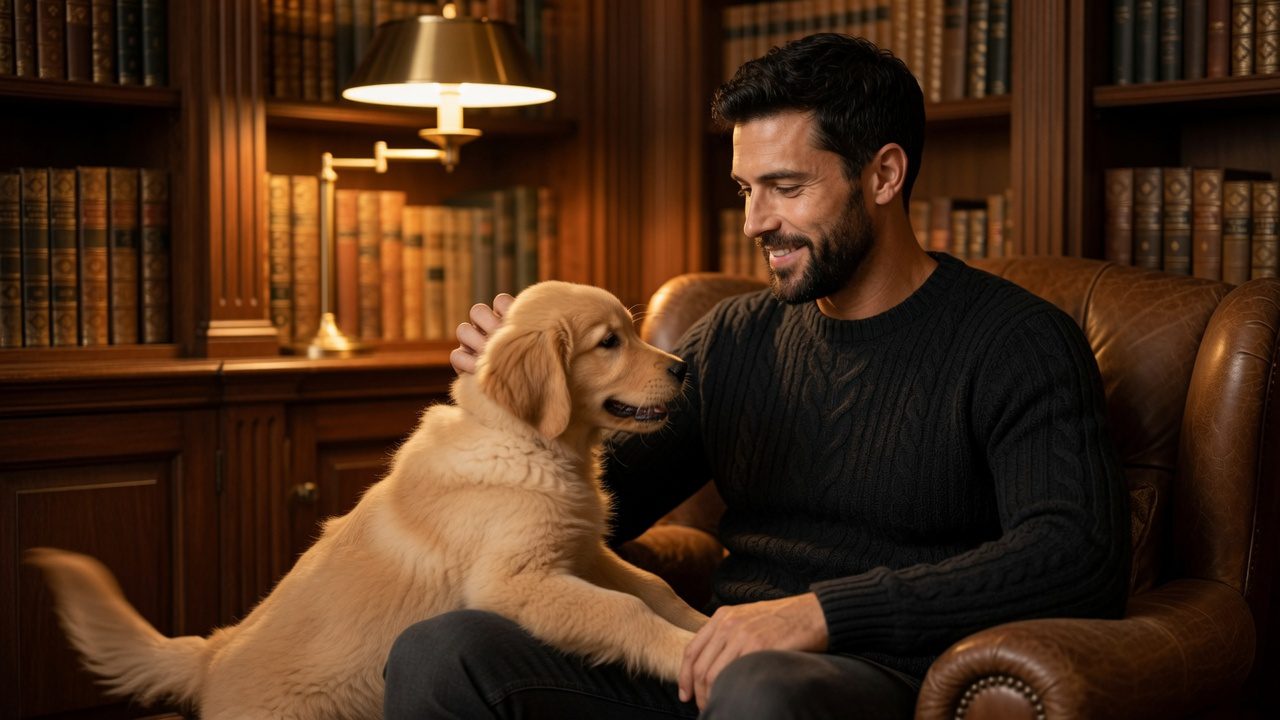
Your dog slips through the doorway before you do. They lean their weight into your leg, plant both paws on your chest, or settle onto the sofa as though they own it. Somewhere along the way, most of us were taught to read these moments in the same way: your dog is trying to be the boss.
It is a comforting story, and for a long time it was the only one on offer. But the idea of the alpha dog turns out to be mostly a misunderstanding, and letting it go is one of the kindest things you can do for your dog.
Where the alpha dog idea came from
The ‘alpha dog’ idea grew out of studies of captive wolves in the middle of the last century. Watching unrelated wolves thrown together in an enclosure, researchers saw constant tension and competition, and described a rigid hierarchy topped by an ‘alpha’. The picture spread quickly, and before long it was being applied to family dogs and dog training everywhere.
There was just one problem. Wild wolves do not actually live like that. When scientists began watching wolves in the wild, they found something far gentler: a family. A breeding pair and their growing pups, cooperating rather than competing. The very researcher whose work made the word ‘alpha’ famous later spent years asking people to stop using it, because it described an artificial situation, not natural life.
Dogs, of course, are not wolves at all. They have spent thousands of years evolving alongside us, reading us, sharing our homes, and becoming remarkably skilled at reading human emotions and routines. Measuring them against a misread study of captive wolves was never going to tell us much.
What ‘dominant’ behaviour usually is
Once you set the old idea down, the behaviours it tried to explain begin to make far simpler sense.
A dog who barges through the door first is usually just excited to get where they are going. A dog who leans on you, or sits on your feet, is seeking closeness and comfort. Paws on your shoulders are almost always an overjoyed hello and a wish to reach your face. Pulling on the lead is often nothing more than excitement about a world full of fascinating smells.
None of these are moves in some quiet battle for power. They are a dog being a dog: excited, affectionate, unsure, or simply never taught a calmer habit. Your dog is not plotting to run the household. They are trying to feel safe, to stay close to you, and to work out what you would like.

The gentler question
One small change makes all the difference. Instead of asking, “Is my dog trying to be dominant?”, we can ask, “What does my dog need right now, and what are they feeling?”
That single shift turns a power struggle into a conversation. A dog who jumps up is not challenging you; they are asking for attention, and can be shown a lovelier way to say hello. A dog who guards the sofa is not staging a takeover; they may be anxious, and need help feeling secure. The behaviour still matters. The story we tell about it is simply kinder, and far more useful.
Body language is often considered one of the most honest forms of communication, because so much of it happens without conscious thought. When we read our dogs this way, we stop looking for defiance and start seeing the truth: an animal telling us, moment by moment, how they feel.
Why it is worth letting go
This is not only a nicer way to think. It is a better one. The old alpha idea led to confrontational training, to methods built on intimidation and ‘showing the dog who is in charge’. We now know that these approaches often increase fear and aggression, and quietly wear away the trust between a dog and their person.
Kindness is not the soft option here. It is the effective one. Dogs who feel safe, understood and gently guided learn more, worry less, and grow closer to the people they live with.
If you were once taught the alpha story, there is nothing to feel badly about. Almost all of us were. It made sense with what we knew at the time. Learning something better is not a failure. It is exactly how good owners grow.
Reading the whole dog
A dog on the sofa, a dog through the doorway, a dog with their paws on your chest: not one of these is a single word that means ‘dominance’. The real meaning always lives in the whole picture, in the body, the eyes, the situation, and what your dog is feeling underneath it all.
That gentle way of seeing is the heart of our little book, Fluent in Dog. Together with Maya, Leo and Finn, our curious golden retriever, it walks you through the whole language, so that you can meet your dog not as a rival to manage, but as a companion to understand.
Your dog has been speaking all along. We simply had to learn a different language.
The Quiet Paw Press 🐾
Leave a Reply