
The walk, the meal and the game are the parts we notice. Your dog also lives through the minutes on either side, and that is often where the difficulty actually sits.
The game finishes because Leo’s phone rings.
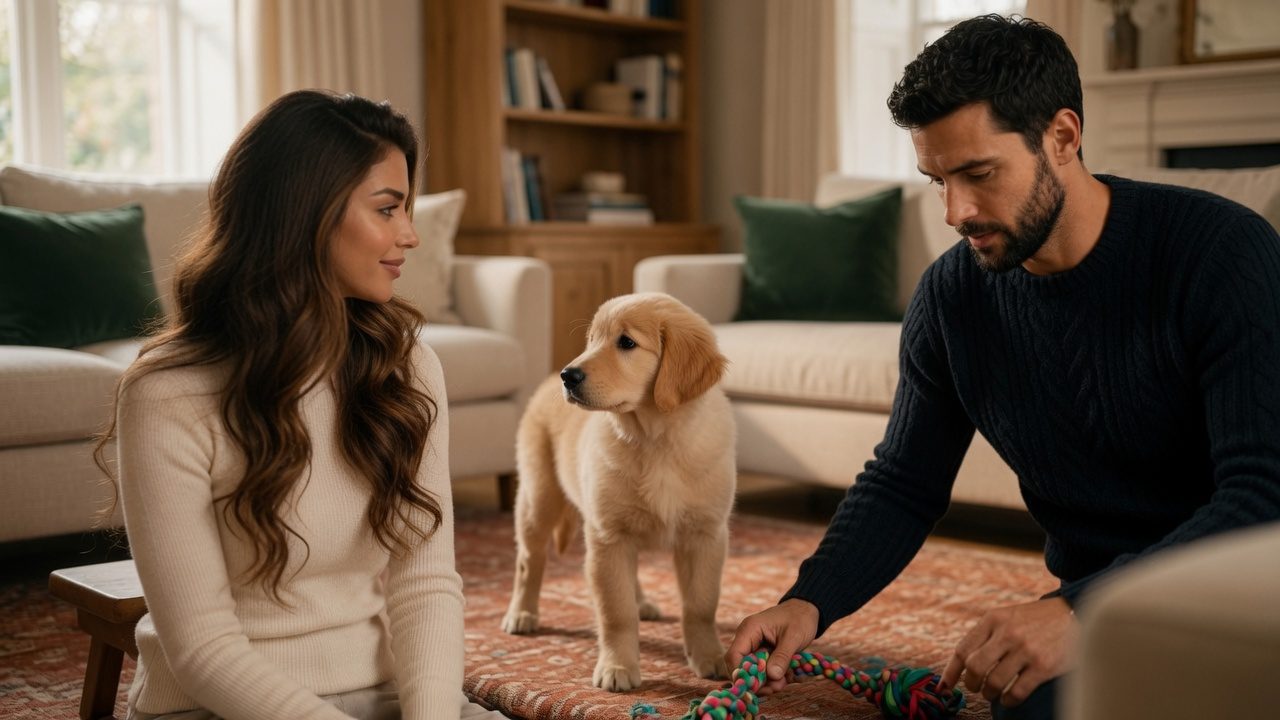
He drops the rope toy on the rug, says “that’s enough now”, and walks into the hall to take the call. Two minutes ago Finn, Maya and Leo’s five-month-old golden retriever, was bouncing, grabbing, letting go, spinning round and grabbing again.
Now Finn is standing in the middle of the room with the rope in his mouth. He brings it to Maya. She says no thank you. He brings it again. He drops it on her foot, picks it up, takes it to the sofa, comes back, and does a fast lap of the coffee table. Then he stands in the doorway Leo went through and barks once.
Maya reads this as a request to keep playing. Leo, coming back in, sees something slightly different. The game did not wind down. It stopped, mid-air, at the highest point of the afternoon, and nothing that followed told Finn what was supposed to happen instead.
Both readings could be partly right. What is definitely true is that the difficult bit was not the game.
The difficult part may be the middle
We tend to think about a dog’s day as a list of events. Breakfast, walk, nap, play, dinner, evening, bed.
Dogs live through the joins as well. The build-up to the walk, the wind-down after it, the moment a visitor’s coat comes off the hook, the ten minutes after a burst of play, the shift from a busy household evening into a quiet house at eleven at night.

Those passages can carry more intensity than the events they connect. A dog who is perfectly happy on a walk may be almost unmanageable in the four minutes before it. A dog who plays beautifully may find stopping much harder than starting. Look at the joins rather than the events, and a surprising number of everyday complaints start making more sense.
What can make a transition hard
Several things can be in the mix, and they are not all the same thing.
Anticipation. Your dog has learned what tends to follow what, so the excitement often begins long before the event does.
Speed. A change that happens abruptly gives a dog nothing to move through, only something to land in.
Activation that has not come down yet. Excitement, in the nervous system sense, does not switch off at the moment the fun stops. A body that has been running, grabbing and spinning may need time to come back down. That does not automatically make the behaviour a problem.
Endings that are not readable. The game is over in your head. Nothing in the room has told your dog.
Frustration. Something enjoyable stopped and there is no obvious route back to it. Frustration looks a lot like naughtiness and is not the same thing at all.
Uncertainty. Especially when the routine has changed, or the sequence is one your dog has not met many times before.
Any of those may be present. So may none of them, because dogs are also sometimes just tired, or hungry, or five months old.
The transition starts earlier than you think
Ask most people when the walk begins and they will say when the lead is clipped on.
Ask a dog and the answer may be considerably earlier. The socks going on. A particular pair of shoes. The tone of voice people use when they are about to go out. The phone going into a back pocket. Any of these can become the real first note of the sequence, because they have repeatedly come before the walk.
The same is true across the day. Dinner may begin with a cupboard door. Visitors may begin with someone plumping cushions and moving a chair. Bedtime may begin when a lamp goes off and the movement in the house slows.
None of these cues is calming or exciting in itself. It borrows its meaning entirely from what has repeatedly followed it. That also means the loud part of a transition can often be traced back to something small and much earlier, which is usually where an adjustment is easiest to make.
If you want to see where your own household’s sequences really start, a week of simple notes will show you faster than trying to remember.
The half that gets forgotten
Coming out of an event gets far less attention than going into one, and it is often the harder half.
The end of a walk. The end of a game. A guest leaving. A training session finishing. The moment your attention goes back to the laptop. In each case something enjoyable has stopped, the dog is still switched on, and it is not obvious what happens now.
It is also worth retiring the idea that a tired dog is automatically a calm dog. A long, stimulating walk can leave a dog physically tired and still highly activated, which is why some dogs come home from the most exciting outing of the week and then pace, pester and cannot lie down. Adding more exercise at that point rarely helps. What may help more is time, a quieter environment and, for some dogs, a simple low-pressure sniffing activity.
Six everyday transitions and what to notice
Getting ready for a walk. Notice how much of the excitement is being added by us. Fast movement, repeated cues, a bright high voice, a lead being waved about. Try doing the whole preparation more slowly and more boringly than feels natural, and see whether anything changes over a week.
Coming home from a walk. Notice what happens in the first ten minutes through the door. A drink, a chance to potter about, somewhere comfortable, no demands. Many dogs are asked to be immediately calm at exactly the moment their bodies have not caught up yet.
Ending a game. Notice whether play stops at the peak. Ending slightly before the highest point, and letting the final minute become gentler than the middle, may make the change easier for some dogs than stopping abruptly. Putting the toy away in a consistent place can also become a small readable full stop.
Guests arriving. Notice how much of the intensity is in the hallway rather than the visit. The doorbell, the coats, the raised voices, the crowd in a narrow space. Meeting people in a larger room, or a couple of minutes later, can change the whole shape of the visit.
Guests leaving. Notice the emptiness afterwards. The house was full of people and interesting things, and then the door closed. A short sniffing activity or simply moving into the next ordinary part of the evening gives the dog somewhere to go next.
Evening into sleep. Notice whether the last hour is recognisable. Lights, television volume, people moving about, the final trip into the garden. Dogs are good at learning the order things happen in, and a familiar order at the end of the day asks less of them than a different one every night.
For each of these, change one thing at a time and give it a week. Change four things at once and you will never know which one mattered.
How to make a transition easier
A few principles, none of which is a technique and none of which comes with a guarantee.
Start earlier. Work on the quiet beginning of the sequence rather than the loud middle of it.
Take the ceremony out. Fewer announcements, less fuss, slower hands. Our own excitement is one of the ingredients, and it is the one we can change most easily.
Make the next step readable. The most useful thing you can offer at the end of an activity is not stillness but information. Something is happening now, and here it is.
Let activation come down instead of demanding calm. You cannot ask a body to be quiet before it is ready. You can make the room quieter and let it happen.
Leave choice where you can. Leaving room to move away, choose another resting place or take a moment can make the transition feel less pressured.
Keep sequences familiar without becoming rigid. Dogs use all kinds of information about time and order, and what they learn most reliably is the shape of the sequence, not the exact minute on the clock.
Watch your own dog rather than the plan. If a ritual is not helping after a fortnight, it is not the right ritual for this dog. Our guide to reading the whole dog in context is useful here, because the answer is usually in his body rather than in the schedule.
Calm should not be the price of the walk
There is a popular idea that a dog should be perfectly still before he gets anything he wants. Sit quietly or the lead does not go on. No greeting until all four feet are on the floor and the excitement has drained away.
There is a reasonable instinct underneath it, which is that we do not want to keep adding intensity to an already intense moment. But taken as a rule, it turns every transition into a test, and it can make things worse rather than better. A dog who is desperate to go out and is now also unable to work out how to earn it has more frustration to deal with, not less.
Excitement is not a fault. A dog who is delighted about a walk is having a lovely time. The aim is not to remove that, it is to make the passage from delighted to walking a bit clearer, a bit slower, and a bit less loaded for everyone involved.
When it is not a transition problem
Some things look like difficulty with transitions and need more than a better routine.
Genuine separation-related distress is the clearest example. A dog who panics when left, who vocalises for long periods, who injures himself, damages doorways or windows trying to get out, or who cannot settle at all in your absence, is not having a routine problem. A calmer departure sequence may be part of a plan eventually, but it is not the plan, and it is not a substitute for proper support. That is a conversation for your vet and a qualified reward-based behaviour professional.
The same applies to any sudden change, to a transition that used to be easy and has become difficult, to signs of pain such as stiffness or reluctance to be touched or handled, to any escalating behaviour, and to anything involving growling, snapping or a risk of a bite. Difficulty settling can have physical causes, and no amount of good sequencing at home will identify those.
And a gentle note about puppies. Moving from excitement into rest is something young dogs are still learning to do, and some need a good deal of help with it for a while. That is not a flaw in the dog, and it is not a training failure. It also varies enormously between individuals, and between the same dog on two different days.
Back to the rope on the rug
A few evenings later, the game ends differently. Not because anyone read a rule, but because Leo tried something.
He slows the last minute of play instead of stopping at the top of it. When it finishes, the rope goes into its basket where Finn can see it happening. Maya scatters a small handful of Finn’s dinner across the rug, and he spends a couple of minutes searching slowly across it. Then the evening carries on, and nobody asks him for anything.
He still gets up twice. He still checks the doorway once. But he lies down after about five minutes rather than pacing for twenty, and on the next two evenings something similar happens.
That is not a solution and nobody has fixed anything. What changed is smaller and more useful than that. Maya and Leo stopped thinking of the end of play as empty time after the good bit, and started treating it as part of the good bit.
Most of a dog’s day is made of these joins. Not the walk, but getting ready for it. Not the visitor, but the hallway. Not sleep, but the hour beforehand. Once you begin to see these joins, they become places where one small change can sometimes make the whole day easier to follow.
If you would like to explore this further, Quiet Trust looks at how rhythm, familiar sequences and the moments between events help a dog feel secure in everyday life. The link takes you to the book page.
Leave a Reply