By Maya & Leo | The Dog Psychology Podcast
The story almost always starts the same way.
“He was the gentlest dog. Never once snapped at anyone. Seven years, not a single incident. And then, out of nowhere, he bit my daughter. Just like that. No warning. Nothing.”
No warning.
Those two words appear in nearly every account of a dog bite involving a family pet. And in nearly every case, they are not accurate, not because the owner is lying, but because they genuinely did not see what was right in front of them.
This is not a story about dangerous dogs.
It is a story about a language barrier. One that most people do not even know exists.
“Out of Nowhere”: The Myth That Gets Dogs Killed
Dogs almost never bite without warning. This is not a hopeful claim. It is what decades of canine behaviour research consistently shows. Dogs are, by nature, conflict-averse. Biting is expensive for them. It risks injury, it escalates situations, it breaks the social bonds they depend on. Before a dog bites, they almost always try everything else first.
The problem is that “everything else” is written in a language most humans were never taught to read.
Dr. Sophia Yin, one of the most influential veterinary behaviourists of the last thirty years, spent much of her career documenting exactly this gap. In study after study, slow-motion video analysis of incidents described as “unprovoked” revealed a consistent sequence of warning signals (signals the dog had given, sometimes for minutes, sometimes for years) that went completely unnoticed by the humans around them.
The dog was not silent. The humans were simply not listening.
And that distinction matters enormously, because a dog that bites “out of nowhere” is considered unpredictable, dangerous, unreliable. A dog whose warnings were missed is a dog who was failed by the people around them.
One ends up euthanised. The other gets the help they need.
Calming Signals: The Warning System You Were Never Taught
In the 1990s, a Norwegian dog trainer and behaviourist named Turid Rugaas introduced a concept that has since become foundational in modern dog behaviour work: calming signals.
Rugaas noticed, through years of careful observation, that dogs use a remarkably consistent set of small, subtle behaviours to communicate stress, discomfort, and the desire to de-escalate a situation. These are not dramatic signals. They are not growling or snapping or raised hackles. They are quiet, easy-to-miss, completely ordinary-looking behaviours that dogs produce constantly, and that most humans walk past without a second glance.
Learning to see them is like getting a pair of glasses you did not know you needed.
Suddenly, what looked like a calm dog is revealed as a dog working extremely hard to hold it together.
Dog Stress Signals Explained: One by One
Whale Eye
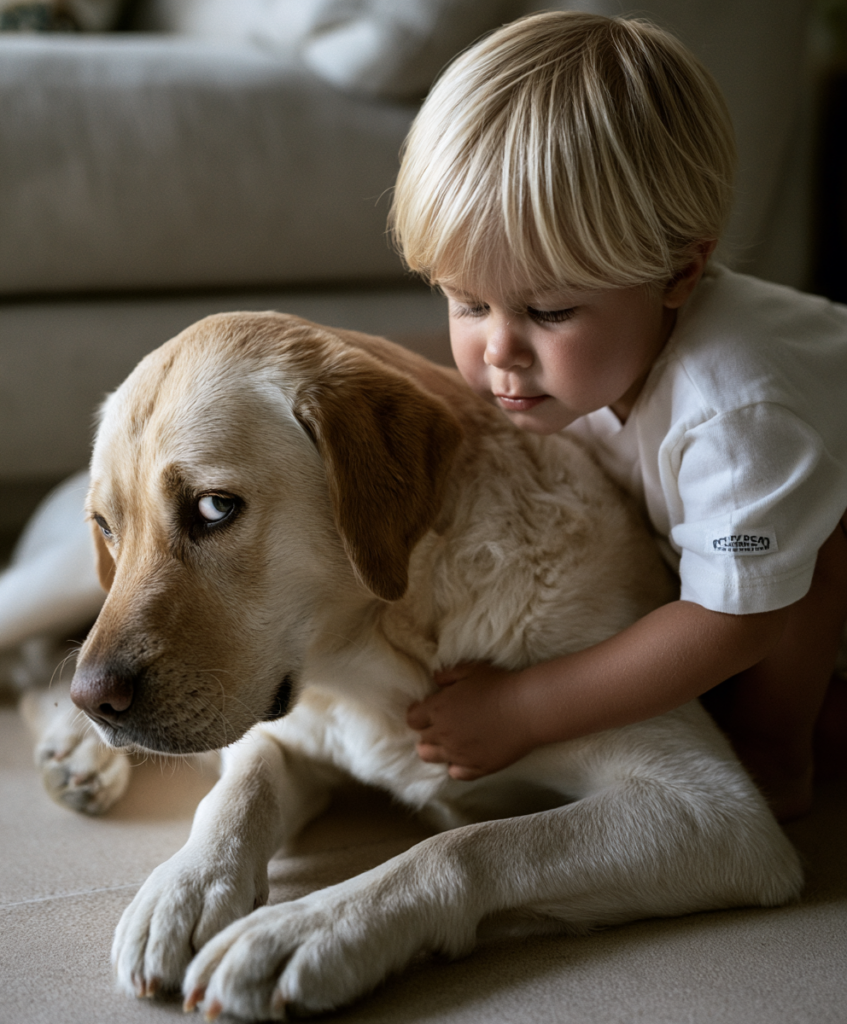
Whale eye is what happens when a dog turns their head slightly away from something that is making them uncomfortable, but keeps their eyes fixed on it. The result is that you can see the whites of their eyes, that crescent of white at the outer edge, in a way you normally would not.
Think about the last time you saw a dog being hugged by a small child and thought they looked “so patient,” “so tolerant,” “so sweet.” Now ask yourself: were you looking at their eyes?
A dog showing whale eye during a hug is not being patient. They are showing you, as clearly as their biology permits, that they are deeply uncomfortable and would very much like this to stop. The head turn is an attempt to create distance from the thing that is stressing them. The fixed eyes are because they do not feel safe enough to look away entirely.
That dog is not enjoying the hug. That dog is tolerating it. For now.
Lip Licking and Tongue Flicks
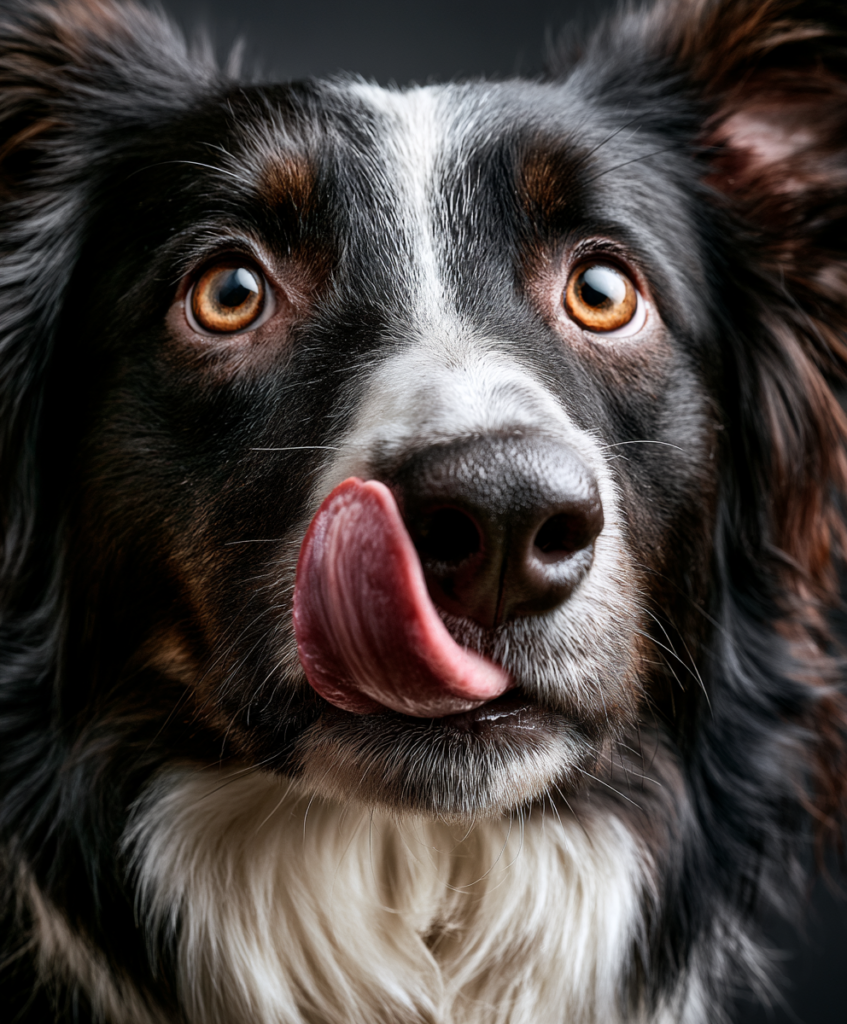
Lip licking as a stress signal is particularly easy to miss because it is fast. A single, quick flick of the tongue, up over the nose, or just at the corner of the mouth, lasting less than a second.
In a normal context, we assume a dog licking their lips is thinking about food. But when a dog produces a rapid tongue flick in response to being approached, touched, hugged, or stared at, with no food anywhere in the picture, it is a stress signal.
It often appears in photographs. You can see it clearly in the fraction of a second before the shutter clicks: the child leans in for a hug, the dog licks their lips. The photo captures the hug, looking adorable. The tongue flick is already gone.
Watch for it in videos. Once you start looking, you will see it constantly.
Stress Yawning
Not every yawn is a stress signal. Dogs yawn when they are tired, just as we do. But a yawn that appears in the middle of an interaction, when the dog has not just woken up and is not particularly sleepy, is something different.
Stress yawning in dogs tends to be exaggerated, wide mouth, sometimes with a soft vocalisation, and it appears at moments of social pressure. When a stranger reaches down to pet them. When a child gets in their face. When the owner raises their voice.
It is the dog equivalent of taking a very long, deliberate breath. A physical attempt to down-regulate a nervous system that is running a little too hot.
Freezing
This one is arguably the most critical signal on the list, and one of the most dangerous to miss.
Freezing is exactly what it sounds like: the dog goes completely still. Not the stillness of a dog watching a squirrel, all forward energy and focused attention. This is a different kind of still. Rigid. Held. Like a system that has temporarily stopped processing.
In behavioural terms, freezing is often the last signal before a bite. It represents a dog who has run out of other options. They have licked their lips, yawned, looked away, turned their head, and none of it has worked. The uncomfortable thing is still happening. And now they have nothing left except to stop moving and figure out what to do next.
If a dog freezes while being touched or handled, stop what you are doing. Immediately. Give them space. Do not interpret the stillness as acceptance or calm. It is neither.
Head Turning and Looking Away
Dogs use the direction of their gaze very deliberately. Direct eye contact, in dog language, carries the potential for threat. A dog who turns their head away from you, or averts their gaze, during an interaction is signalling: I am not a threat. Please be not a threat back.
When a child thrusts their face toward a dog’s face and the dog turns away, that is not the dog ignoring the child. That is the dog trying, very politely, to de-escalate a situation that feels threatening.
When the child pursues, following the dog’s turn with their own face, and the dog turns away again, more emphatically, that sequence matters. The dog is trying to communicate. The child is not receiving the message. And the gap between those two things is exactly where incidents happen.
Soft Body vs. Hard Body
Beyond specific signals, there is a more general quality to watch for: whether the dog’s body is soft or hard.
A relaxed dog is physically loose:
- Weight shifts easily, they lean into touch
- Muscles have a fluid, easy quality
- Tail wags with the whole back end, not just the tip
- Jaw is loose, sometimes slightly open
A stressed dog goes hard:
- Muscles tighten visibly
- Movement becomes deliberate rather than fluid
- Tail wag becomes stiff, high, short rapid arcs
- Weight shifts forward onto the front legs
Two dogs, both with tails wagging, can be telling you completely different things. The body knows.
The Anthropomorphism Trap
Humans are wired to read human emotions onto the faces and bodies of other creatures. It is not a character flaw. It is how our social cognition works. The problem is that dog faces are not human faces, and dog emotional expressions do not map onto human ones the way we instinctively assume.
The “Guilty Look”
You come home. Something has been chewed. The dog immediately goes into the posture you know well: ears back, eyes soft and wide, body low, tail tucked. You interpret this as guilt.
Research by Alexandra Horowitz at Barnard College found that the “guilty look” is not guilt at all. It appears in response to your behaviour, not to what the dog did. Dogs whose owners returned with an accusatory tone showed the “guilty look” whether or not they had actually done anything wrong. Dogs who had genuinely misbehaved but whose owners returned neutrally showed no “guilty look” at all.
The posture is appeasement, not guilt. The dog is reading that you are unhappy and immediately trying to de-escalate. When you interpret it as guilt and respond with punishment, you are punishing a dog for trying to communicate with you.
The “Smile”
Some dogs pull their lips back in what looks, to human eyes, like a smile. It can be a signal of genuine pleasure. But it can also be a high-arousal appeasement gesture, indicating the dog is working very hard to signal that they are not a threat.
Context is everything. A dog who “smiles” when surrounded by excited children is not showing happiness. They are using every tool they have to try to make the discomfort stop.
The “Tolerant” Dog
This is perhaps the most dangerous anthropomorphism of all.
“He just loves kids. He lets them do anything: pull his ears, climb on him, take his food. He never complains.”
The word “lets” is the problem. Dogs do not “let” things happen because they have consented. They tolerate things because they have learned that resistance does not work, or because they are suppressing their discomfort rather than expressing it.
A dog who has given up signalling is not a safe dog. They are a dog whose warning system is silent until one day, under enough pressure, it is not.
The Worst Thing You Can Do: Punish the Growl
A dog growls. The owner punishes it. The growling stops.
They think they have solved the problem. They have made it catastrophically worse.
A growl is not an act of aggression. A growl is communication. It is the dog using the most unambiguous signal in their vocabulary to say: I am uncomfortable. I need this to stop. I am telling you clearly before I do something I cannot take back.
When you punish the growl, you do not address whatever was causing the dog’s discomfort. The discomfort is still there. You have simply removed the dog’s most effective way of communicating that fact.
Dr. Ian Dunbar, founder of the Association of Pet Dog Trainers, puts it simply: a dog who growls is doing you a favour. They are giving you information. They are giving you time. Punish the growl and you lose both.
What you are left with is a dog who has learned that warning is not safe, and who has been trained by the people they trust most to skip the warning and go straight to what comes next.
The Bite Ladder: What Escalation Actually Looks Like
Dog behaviour researchers use what is called the “ladder of aggression” to describe the sequence of signals that typically precede a bite. Biting is the last rung, not the first.
A dog working through stress will typically try, in rough order:
- Turning away
- Yawning
- Lip licking
- Moving away, if they can
- Whale eye
- Freezing
- Low growl
- Raised lip
- Snap (usually landing on air, a final warning)
- Bite
Most bites happen to people who missed everything from the lip lick to the snap. Most bites described as “out of nowhere” were preceded by months, sometimes years, of the earlier signals being ignored or misread.
This is particularly important for owners of high-drive working breeds. Australian Cattle Dogs and other herding breeds are wired for intense environmental monitoring and have extremely low tolerance for chaotic, unpredictable interactions. Their stress signals can be fast and subtle precisely because they are so attuned to their surroundings. A Cattle Dog who has been repeatedly overwhelmed by children or strangers will move through the bite ladder more quickly than a more laid-back breed, not because they are more aggressive, but because their nervous system processes threat more efficiently.
Children and Dogs: The Gap in Understanding
Children are the most common victims of dog bites, and the reason is almost entirely this language gap.
Children move fast, make sudden sounds, invade physical space without awareness, and interpret a dog’s stillness as an invitation rather than a warning. They hug dogs around the neck, a behaviour that in dog social language resembles a dominance gesture rather than affection. They put their faces directly in front of a dog’s face, making the kind of sustained eye contact that, in canine terms, is a challenge.
None of this is the child’s fault. They are being children.
The responsibility lies entirely with the adults in the room, and specifically with whether those adults can read the dog well enough to intervene before the dog has to.
The single most protective thing an adult can do is watch the dog, not the child. The child’s behaviour is visible and obvious. The dog’s communication is subtle and fast and requires active reading.
When supervising a dog-and-child interaction, look for:
- Tongue flicks
- Head turns or gaze aversion
- Body going hard
- Whale eye
- Any freezing
And if you see any of it, move. Create space. Let the dog leave if they want to. Do not tell the child to be gentle. Remove the pressure entirely.
What a Truly Relaxed Dog Actually Looks Like
A genuinely relaxed dog in a social situation looks very different from a dog who is simply suppressing their signals:
- Soft, slightly unfocused eyes
- Loose jaw, sometimes slightly open
- Tail wagging with the whole back end
- Weight shifting easily, leaning into touch without stiffening
- Moving away when they choose, then coming back when they choose
- Taking food gently rather than frantically
A dog who is repeatedly retreating to their bed, hiding under furniture, leaving the room when children enter, or going still when handled is telling you something. Not about their character. About their experience.
The absence of biting is not the same as the presence of comfort.
Learning the Language
The good news is that canine body language is learnable. It takes attention and practice, but it is not complicated. You do not need a degree in animal behaviour.
You need to watch your dog.
Watch them when they are relaxed so you know what relaxed looks like for them specifically. Watch them when they are being handled. Watch them around children, strangers, other dogs. Watch their eyes, their jaw, their tail, their weight distribution.
Start with whale eye, because it is distinctive once you know what you are looking for. Practice spotting it in videos online. Then bring that attention into your real interactions with your dog.
Because here is what is on the other side of learning this language: not just safety, though it is that. It is the ability to actually hear your dog. To know, in real time, whether they are comfortable or not. To be the person in the room who noticed, and intervened, and gave them the space they needed.
Dogs spend their entire lives trying to communicate with us in a language we were never taught.
Learning even a fraction of it is the least we can do.
Maya & Leo host The Dog Psychology Podcast, exploring the hidden emotional life of dogs for owners who want to go beyond the basics. New episodes every week.