
By Maya & Leo | The Dog Psychology Podcast
It probably happens in your house too.
The lights go off. The duvet settles. And then, the familiar sound of paws on the floor, the slight bounce of the mattress, the warm weight pressing against your legs or curling somewhere near your feet.
And somewhere in the back of your mind, that voice again.
“You’re letting them think they’re the boss.”
That voice has been wrong this whole time.
What your dog is actually communicating when they choose to sleep beside you is far more fascinating, far more emotionally layered, and honestly far more moving than any dominance theory ever gave them credit for. Understanding it won’t just change how you think about your dog at night. It will change how you understand everything they do.
So let’s start from the beginning.
The Oldest Arrangement in Human History
Before we get into what your dog’s specific sleeping position means, we need to go back. Way back.
Co-sleeping between humans and dogs is not a modern indulgence born of soft hearts and Instagram aesthetics. It is, in evolutionary terms, one of the oldest living partnerships on this planet.
For somewhere between 15,000 and 40,000 years (depending on which archaeological evidence you look at), dogs and humans have slept together. Not because one was dominant over the other. Not because someone lacked discipline. But because proximity meant survival.
Warmth on cold nights. A shared early warning system against predators moving in the dark. The simple biological comfort of another heartbeat nearby.
Think about what that era actually looked like. We are talking about the Pleistocene, the ice age. Not climate-controlled environments and insulated walls. The environment was brutally unforgiving, freezing, populated by megafauna that could kill a human without much effort. In that context, a dog’s body temperature, which sits naturally higher than a human’s, was not a comfort. It was survival technology. Packing a few high-temperature canines into a shelter with human bodies was the original central heating system.
And the dogs complemented human weaknesses in other ways too. Humans have terrible night vision. Our hearing is decent but not exceptional. Our sense of smell, compared to a predator, is practically non-existent. Dogs covered every one of those deficits: acute hearing that registered frequencies we cannot, olfactory receptors thousands of times more sensitive than ours, and a deeply ingrained instinct to wake and alert the group to any novel change in the environment. They were the original home security system, running on instinct refined over thousands of generations.
The ancestors of our dogs were not solitary creatures. They were deeply social animals who slept in physical contact with their group, a behaviour rooted not in hierarchy, but in attachment. Safety was not just about resources or rank. Safety was about nearness.
When your dog navigates their way across your bed tonight and settles with a sigh against your legs, they are not making a power move.
They are doing what their species has done for tens of thousands of years.
They are choosing to be near you.
Why the “Dominance” Myth Refuses to Die
You have almost certainly heard some version of this theory. Dogs are descended from wolves. Wolves have pack hierarchies. Therefore, if you let your dog on the bed, they will believe they are the alpha, and everything in your household will slowly descend into chaos.
It sounds plausible, feels logical. Modern behavioural science has thoroughly dismantled it.
The problem starts with the wolves themselves. The original research that gave us the “alpha” concept was conducted in the 1940s by Swiss animal behaviourist Rudolf Schenkel, and critically, it was conducted on captive wolves forced together from different families. Unrelated animals, captured from different regions, confined together in zoo enclosures with artificially limited resources.
The analogy that captures it best: imagine taking ten completely unrelated strangers, locking them in a tiny house, depriving them of adequate food, giving them zero privacy, and forcing them to compete for a single bathroom. Obviously there would be screaming and fighting. Now imagine an alien scientist watched that unfold and published a paper concluding that human families naturally operate through violent dominance and hostility. That is, more or less, what happened with Schenkel’s wolves. He was not observing natural behaviour. He was observing the trauma response of stressed, confined animals in a deeply unnatural situation.
Dr. L. David Mech, who spent decades studying wild wolf packs on Ellesmere Island in Canada, eventually spent the latter part of his career actively trying to correct the record. Remarkable given that his early books had helped popularise the alpha theory in the first place. In the wild, he found, wolf packs are overwhelmingly made up of family groups: parents and their offspring from the past few years. The social organisation looks far less like military hierarchy and far more like, well, a family. Parents lead because they have experience. Young ones follow because they are the children. Nobody is constantly challenging for dominance. They are just living together.
But even setting the wolf research aside, there is a more fundamental problem with applying any of this to our dogs.
Dogs are not wolves. They diverged from their wolf ancestors thousands of years ago, shaped, deliberately and intensively, by life alongside humans. Through what researchers call domestication syndrome, they changed genetically, physically, and neurologically. They evolved to digest the starchy agricultural scraps humans discarded. They developed the specific facial musculature around their eyes to produce the expressive looks that wolves simply cannot. Wolves lack the muscle structure for it entirely. They developed an innate ability to read human pointing gestures and gaze direction, something even highly intelligent primates struggle with.
Dr. John Bradshaw at the University of Bristol has written extensively on this point: domestic dogs do not perceive their human households as wolf packs. They are acutely aware that we are not dogs. They do not have a biological agenda to climb a social hierarchy. What they have is a profound, biologically wired need for social connection, and you, to them, are the centre of that world.
Letting your dog sleep on the bed does not confuse them about who is “in charge.”
It tells them they are loved, and that they are safe.
Those are not the same thing at all.
Dog Sleeping Positions: What Each One Actually Means
Dogs do not simply flop down wherever is convenient. Their choice of sleeping position, where in the bed, how close, which posture, is a surprisingly precise emotional communication. Most owners never think to read it. Once you know how, you cannot un-see it.
Curled at Your Feet or Legs
This is one of the most common positions, and one of the most consistently misread.
Many owners interpret their dog sleeping at the foot of the bed as a sign of indifference, or weak bonding. The dog wants the mattress, the thinking goes, but doesn’t really want to be near me. It feels like a slight rejection, like being at a dinner party and having someone choose the seat at the absolute opposite end of the table.
Canine ethology flips that reading completely.
A dog who sleeps at your feet is typically a dog who feels secure enough not to require constant physical reassurance. They are close enough to monitor you, feeling the subtle shifts in your breathing, the movement of your legs, the change in your body temperature, without needing to press themselves against you for comfort. The bond is so solid that they do not need to be in your arms to feel tethered to you.
And there is something deeper happening. In ethological terms, sleeping at the “exit point” of the sleeping area, near the feet, near the edge, is associated with a posture of mild environmental monitoring. In the wild, an animal sleeping on the periphery of the group maintains a degree of alertness that one sleeping in the protected centre does not need to. Their head, from that position, has a clear line of sight to the bedroom door and the rest of the room. They can feel the movement of your legs and know you are still there. A primitive part of their nervous system is keeping a quiet watch.
They are not being aloof. They are playing the role of the quiet sentinel. I am secure in our bond. So I will take the watch tonight.
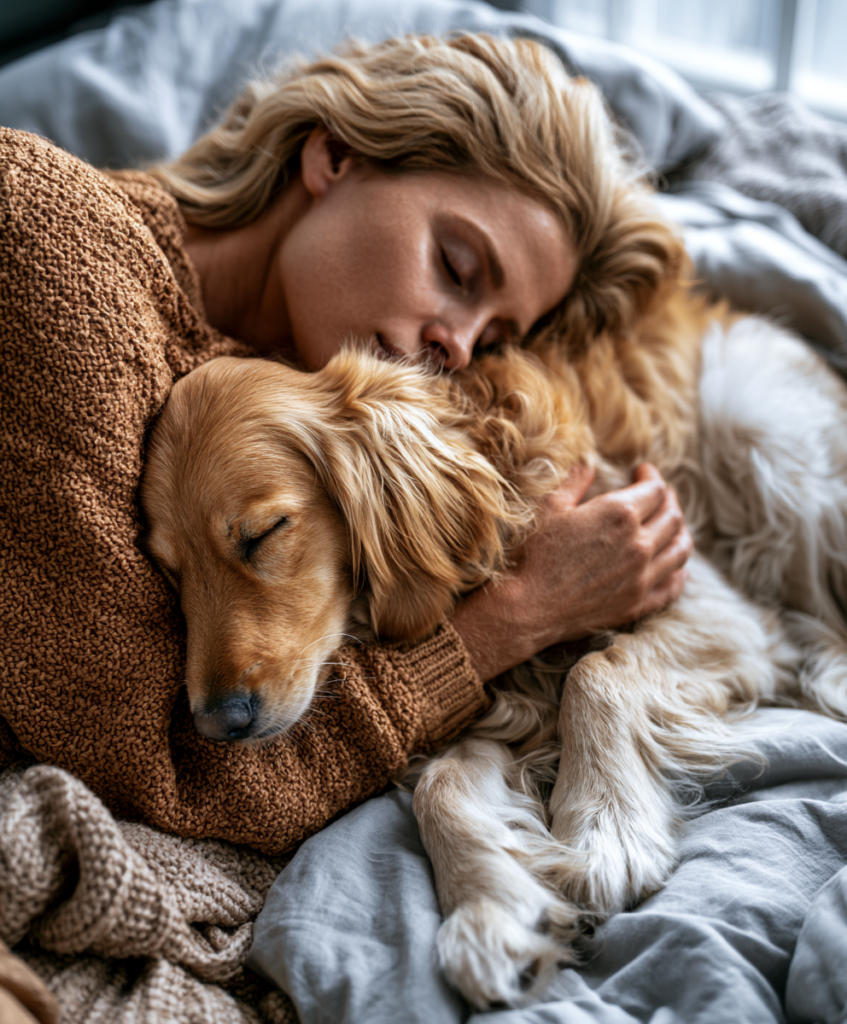
Pressed Against Your Back, Side, or Stomach
This is the sleeping position of deep emotional reliance and trust.
Dogs who seek full-body contact during sleep are not being dominant or demanding. They are seeking co-regulation, a term from attachment science that describes the way one nervous system calms down in response to the proximity of a trusted other.
This is not a metaphor. It is measurable biology.
When a dog presses against your back, they are actively syncing with the rhythmic rise and fall of your breathing, your resting heart rate, your body heat. You become, in a very real physiological sense, their external parasympathetic nervous system, the mechanism that brings their body out of alert and into rest.
Research published in journals including Frontiers in Psychology and Hormones and Behaviour has documented that sustained physical contact between a dog and their bonded human triggers a release of oxytocin in both parties. Oxytocin actively suppresses cortisol production, lowers heart rate, reduces blood pressure, and promotes deep rest. Your dog presses against you not because they are asserting ownership. Out of everything in the world, every toy, every treat, every comfortable spot in the house, your physical body is the ultimate calming mechanism for their brain.
If your dog sleeps pressed against you, they are telling you: you are the place I feel most safe in the world.
Head on the Pillow, Face Near Yours
This is the position that most reliably sets off the “dominance” alarm in anxious corners of the internet.
A dog who sleeps with their head on the pillow, face turned toward yours, is not overstepping. They are engaging in a behaviour that, for them, represents the absolute peak of relational intimacy.
Dogs are the only non-human species that actively seek out soft eye contact with humans as a primary bonding mechanism. Research from Dr. Takefumi Kikusui at Azabu University in Japan found that mutual relaxed gazing between dogs and their owners triggers the exact same oxytocin feedback loop that occurs between human mothers and their infants. Dogs have evolved specific facial musculature around their eyes precisely to make this connection possible. Wolves cannot do this.
A dog sleeping near your face wants to be positioned to read your micro-expressions the moment you wake up. To re-establish that chemical bond immediately.
They are not claiming your territory. They are expressing love in the most profoundly canine way they know.
The Doorway and the Floor
Not every dog wants to be on the bed, and a dog who chooses the floor is not a dog with a weak bond.
First, simple biology. A Husky or a Bernese Mountain Dog with a dense double coat will overheat on a mattress surrounded by human body heat. They seek the coolest tile or the draft under the door purely for thermoregulation.
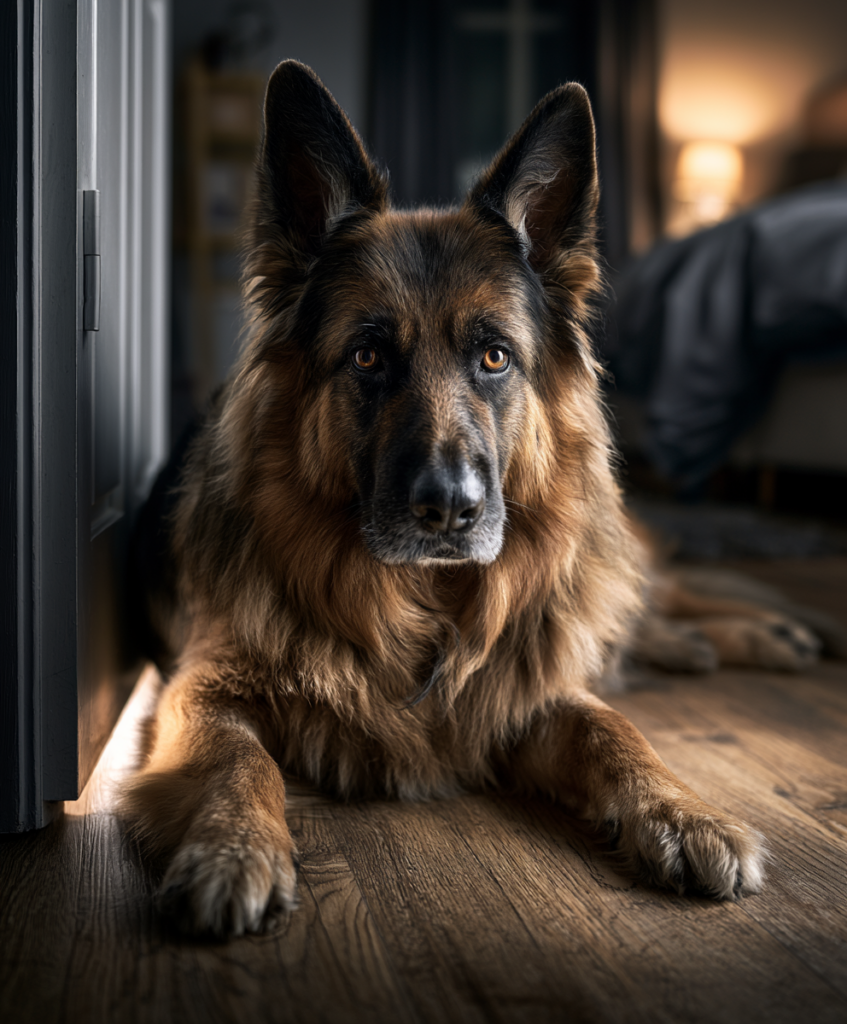
But the location of the floor they choose matters. A dog who positions themselves across the doorway is taking on a specific role. The doorway is the control point of any room, the only way in or out. For a well-adjusted, emotionally secure dog, choosing the doorway is a sign of confidence. They feel their bond with you is solid enough that they do not need physical contact to soothe their nervous system. They feel their role is to look after the pack, and they are self-assured enough to do it from a distance.
You sleep. I’ve got the perimeter.
This instinct is particularly strong in working and herding breeds. Australian Cattle Dogs, bred for generations to monitor, control, and guard their flock, will often choose a position that gives them sight lines to the whole room rather than press against you for comfort. It is not aloofness. It is the behaviour of a dog who takes their job seriously.
When Co-Sleeping Becomes Something Worth Paying Attention To
Everything above assumes a dog who is fundamentally settled and secure. Not all co-sleeping is healthy attachment, and understanding your dog properly means knowing the difference.
Separation Anxiety: The Dog Who Cannot Be Without You
There is a crucial distinction between a dog who wants to sleep with you, and a dog who cannot bear not to.
A secure dog prefers your company. If you shut the bedroom door, they might huff, circle in annoyance, and eventually fall asleep on the sofa. They get over it.
A dog with separation anxiety does not experience annoyance. They experience genuine, overwhelming physiological panic. The signs are recognisable:
- Frantic, destructive attempts to get through the closed door
- Scratching until their paws are raw, chewing the doorframe
- A distress howl that continues long after the house is quiet
- An inability to settle anywhere without direct physical contact with you
- Daytime hyperattachment, pacing if you go to the bathroom and close the door
The crucial point: the co-sleeping is not causing the separation anxiety. It is a symptom of it. Abruptly locking an anxious dog out of the bedroom removes their only coping mechanism while the underlying fear remains completely unchanged. True separation anxiety requires a systematic behavioural modification programme, typically systematic desensitisation, with a qualified behaviourist.
Resource Guarding: A Different Problem Entirely
Resource guarding on the bed is frequently confused with protective behaviour, and the confusion matters enormously.
Resource guarding is a specific behaviour in which a dog perceives the bed, or access to you, as something under threat and responds with defensive aggression. The physical signs are distinct:
- Body goes rigid when someone approaches the bed
- Whale eye: the dog turns their head slightly away but tracks with their eyes, revealing the whites
- Low rumbling growl
- Lifted lip
- Snap or bite if the human does not retreat
A growl is not the bad behaviour. A growl is the warning system, the smoke detector. When a dog growls, they are communicating: I am at my limit. Please stop.
If you punish the growl, you remove the warning without addressing the underlying anxiety. The fire is still burning. You just will not hear the alarm before it escalates. A dog consistently punished for growling will eventually stop warning and go directly to a bite.
Resource guarding on the bed requires professional guidance and, typically, removal of bed access while the underlying emotional response is addressed through counter-conditioning.
The Conversation Nobody Wants to Have: When You and Your Partner Disagree
Perhaps the most practically fraught dimension of co-sleeping is one that gets almost no serious attention in dog training circles.
Two people live in the house. One finds the dog’s presence in bed warm and comforting. The other feels crowded, or allergic, or simply has a philosophical objection. This disagreement runs quietly through thousands of bedrooms, in the muted argument about who moved during the night, in the low-grade resentment of the person who never wanted the dog on the bed but somehow lost the vote.
The research on sleep quality gives both sides something to hold onto. A 2017 Mayo Clinic study using actigraphy trackers found that dog presence in the bedroom produced acceptable sleep efficiency for most participants, but having the dog physically on the mattress produced a slight, measurable drop. Dogs are polyphasic sleepers. Their sleep cycles are shorter and more frequent than ours, meaning they shift, scratch, and reposition multiple times through the night, creating micro-awakenings in the human beside them.
But for participants prone to anxiety or insomnia, the psychological benefits consistently outweighed the physical disruptions. They fell asleep faster and reported feeling more rested. The dog’s presence down-regulated their threat detection system in a way that objective measures could not capture.
What matters most for the dog is not which decision you reach, but that you reach one and maintain it with absolute consistency. A rule that shifts depending on who is more exhausted creates a perpetually uncertain environment for an animal that depends on predictability to feel safe. Uncertainty breeds chronic anxiety. The dog pays the price for the unresolved argument between the humans.
If the compromise is a high-quality dog bed in the corner of the bedroom, most dogs adapt quickly. Their core biological drive is not for your thread count. It is for your presence.
What the Science Actually Says
A few facts worth having clearly, because this topic attracts confident claims from every direction.
On sleep quality: Mixed evidence. Minor objective disruption is real, especially with larger or more restless dogs. Subjective improvement in sleep quality is also real, particularly for people with anxiety.
On allergies: Non-negotiable if documented. The allergen concentration in a room where a dog sleeps is significantly higher than in a dog-free room.
On behaviour: The 2008 research by Hsu and Serpell, which surveyed thousands of dog owners, found zero significant correlation between bed-sharing and behavioural problems. A well-trained, well-socialised dog sleeps on your pillow and wakes up a well-trained, well-socialised dog. The geography of their sleep does not override the quality of your relationship with them.
On immune function: Emerging research suggests that early life exposure to a dog’s diverse microbiome may have modest immune-modulating effects, reducing the likelihood of asthma and certain allergic conditions in children raised in dog-owning households.
The Moment That Changes Everything
Try this.
The next time your dog works their way across the duvet and settles somewhere against your body, instead of immediately calculating whether you should allow it, just stop for a moment.
Look at them.
Notice where they chose. Notice how they oriented themselves. Notice whether they pressed against you or settled a little apart. Notice the sound of their breathing as they relax into sleep, the way the tension leaves their body once they have found their spot.
Your dog does not understand your mortgage, or your work stress, or the argument you had yesterday, or the thing you are anxious about tomorrow. But they understand you, in ways that are older and more physical than language. They know your smell, your baseline breathing patterns, the particular way your body feels when you are relaxed versus tense. They have been reading you, every day, since the moment they first arrived in your life.
And when they choose to sleep beside you, they are telling you, in the oldest language dogs have, that of all the places in the world they could be, they choose here.
They choose you.
That is not a behaviour problem.
That is the whole point.
Maya & Leo host The Dog Psychology Podcast, a space for curious, compassionate dog owners who want to understand the animal they share their life with at a level that actually changes things. New episodes every week.